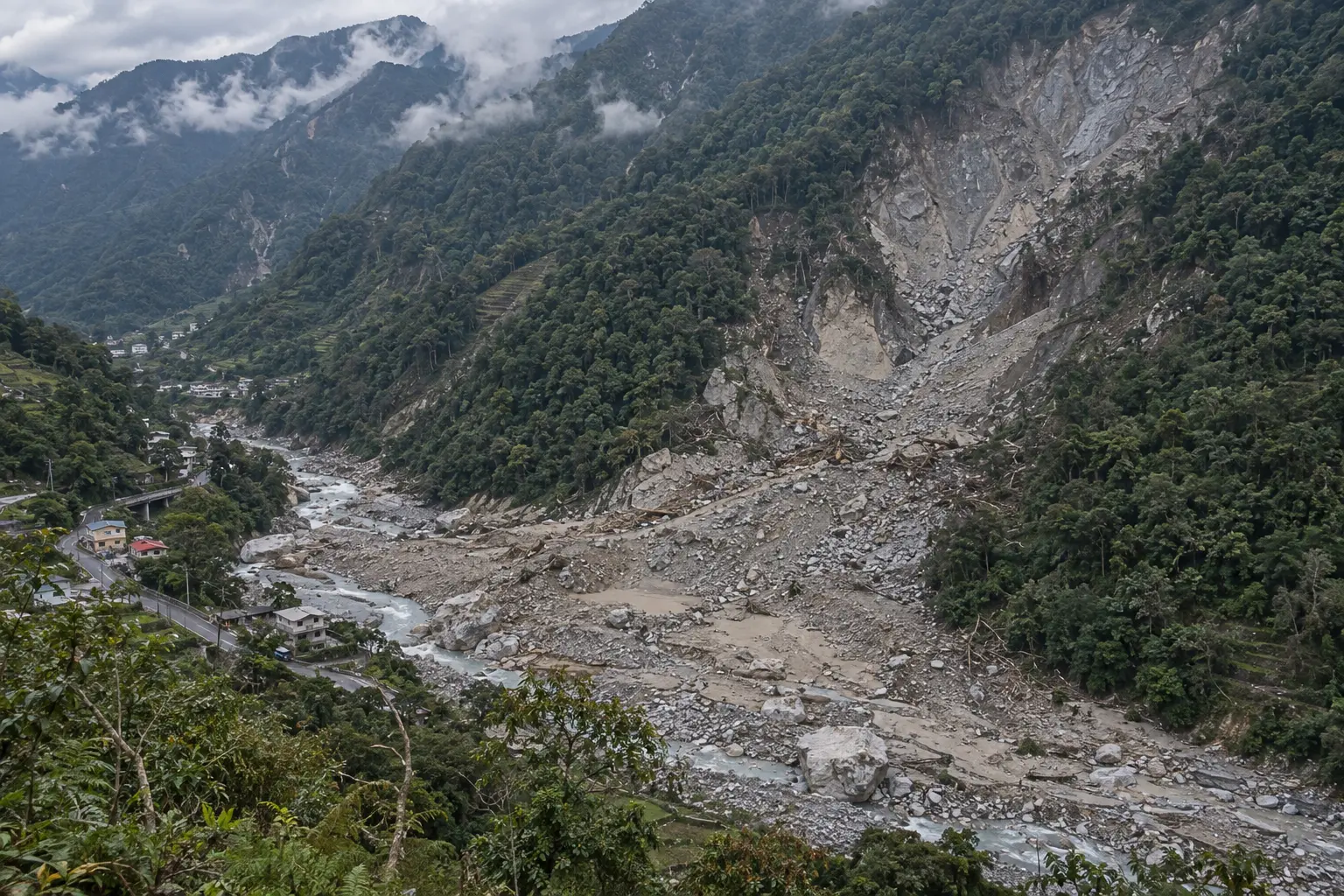
Navigating a Shifting Landscape: Risk Mitigation in Taiwan's Volatile Canyons
You do not need to be told to stay out of a canyon during a typhoon. The real danger comes after — when saturated slopes and earthquake-fractured walls leave the mountain loose and ready to slide. How landslide dams and sudden rockfall create hidden canyon traps, and what genuine risk assessment involves.
You don't need to be told to stay out of a canyon during a typhoon. But what happens after the storm — combined with Taiwan's frequent earthquakes — is where the real danger hides. Heavy rain and tectonic tremors leave the mountain landscape loose, unstable, and ready to slide when you least expect it.
The recent disasters in Nepal and Taiwan show us that mountains don't just reset when the weather clears. They change permanently. Because of this, safely canyoning in Taiwan requires looking beyond basic weather apps and relying on deep, localized risk assessment to manage a changing environment.
Here is how a broken landscape creates hidden canyon traps, and why advanced guiding expertise is essential to mitigate these risks.
1. Managing the Post-Storm Trap: Landslide Dams
When a typhoon drops massive rain, it turns upper mountain slopes into mud. This debris slides into narrow river valleys further up the mountain, acting like a natural, accidental dam that blocks the river and creates a temporary lake.
When the water pressure builds up, these unstable dams burst violently, sending a massive wall of water and rock down into the canyon on a perfectly sunny day.
- The Proof: This exact hazard caused the tragic Matai'an Creek disaster in Hualien, Taiwan. An earthquake followed by a typhoon triggered a massive landslide that blocked the creek, forming a giant barrier lake. Weeks later, the dam suddenly burst, sending an unexpected tsunami down the canyon that killed 19 people.
- The Nepal Lesson: Satellite and seismic data from recent Himalayan floods show the same pattern. A massive rock and ice avalanche collapsed into the mountain river system, briefly damming the valley. When that unstable blockage broke, it released a catastrophic wall of mud and water that wiped out towns downstream.
- The Guide's Role: A professional guide looks at the entire watershed history. Safe guiding involves analyzing satellite imagery, local forestry notices, and upstream weather data from the preceding weeks — not just checking the current day's forecast.
2. Assessing Fractured Walls: The Danger of Sudden Rockfalls
Taiwan sits right on an active tectonic boundary. Earthquakes physically crack our granite and slate canyon walls, leaving millions of tons of boulders balancing precariously right above our standard routes.
- The Proof: The massive 2024 Hualien Earthquake triggered nearly 800 landslides across the mountains. Geologists verified that the tremors deeply fractured the surrounding gorges. Weeks and months later, minor triggers — like a passing animal or hydrostatic water pressure from a simple afternoon shower — sent these pre-loosened rocks crashing down.
- The Danger: A landslide inside a tight slot canyon turns the gorge into a shooting gallery. It can instantly bury deep pools, destroy established anchor stations, or create dangerous boulder piles you cannot climb past.
- The Guide's Role: Experienced guides treat canyon walls as active, living structures. They know exactly where the safe gathering zones are, minimize a team's exposure time in narrow corridors, and carefully select anchor positions that are shielded from overhead trajectories.
Hazard Dynamics & Professional Mitigation
Typhoon Saturation
- The structural impact: Soaks slopes, turning dirt to mud and creating loose upstream dams.
- How an experienced guide mitigates it: Monitors historical watershed data and maps potential barrier lakes before entering.
Earthquakes
- The structural impact: Cracks canyon walls and loosens giant boulder formations.
- How an experienced guide mitigates it: Identifies micro-fractures in the rock and avoids high-risk rockfall corridors.
Narrow Gorges
- The structural impact: Funnels water, mud, and rocks into tight, vertical spaces.
- How an experienced guide mitigates it: Establishes strict "turn-back" deadlines and pre-maps technical exit strategies.
3. Adapting to a Shifting Canyon in Real Time
Because typhoons and earthquakes constantly reshape Taiwan's terrain, you can no longer trust old route maps or last year's trip reports. This is where professional-grade technical adaptability becomes a non-negotiable safety net.
- Dynamic Rigging Skills: Winter floods and shaking ground regularly bend, bury, or rip out existing bolts. Safe canyoning requires guides who possess advanced rigging capabilities — carrying a complete contingency kit (hand drill, bolts, pitons, and webbing) to safely build new anchors on the fly.
- Environmental Literacy: If you are in the canyon on a clear day and the water suddenly turns brown, muddy, or milky, a landslide or dam breach has just occurred upstream. A trained guide recognizes this subtle cue instantly, executing a pre-planned emergency escape to high ground before the surge hits.
The Bottom Line: Taiwan's canyons offer world-class technical descents, but they are alive and constantly shifting. Safely navigating them is not a matter of luck; it requires professional risk management, technical humility, and an acute understanding of what the last big storm or earthquake did to the rocks right above your head.